Right of Redemption After Foreclosure: A Guide for Investors
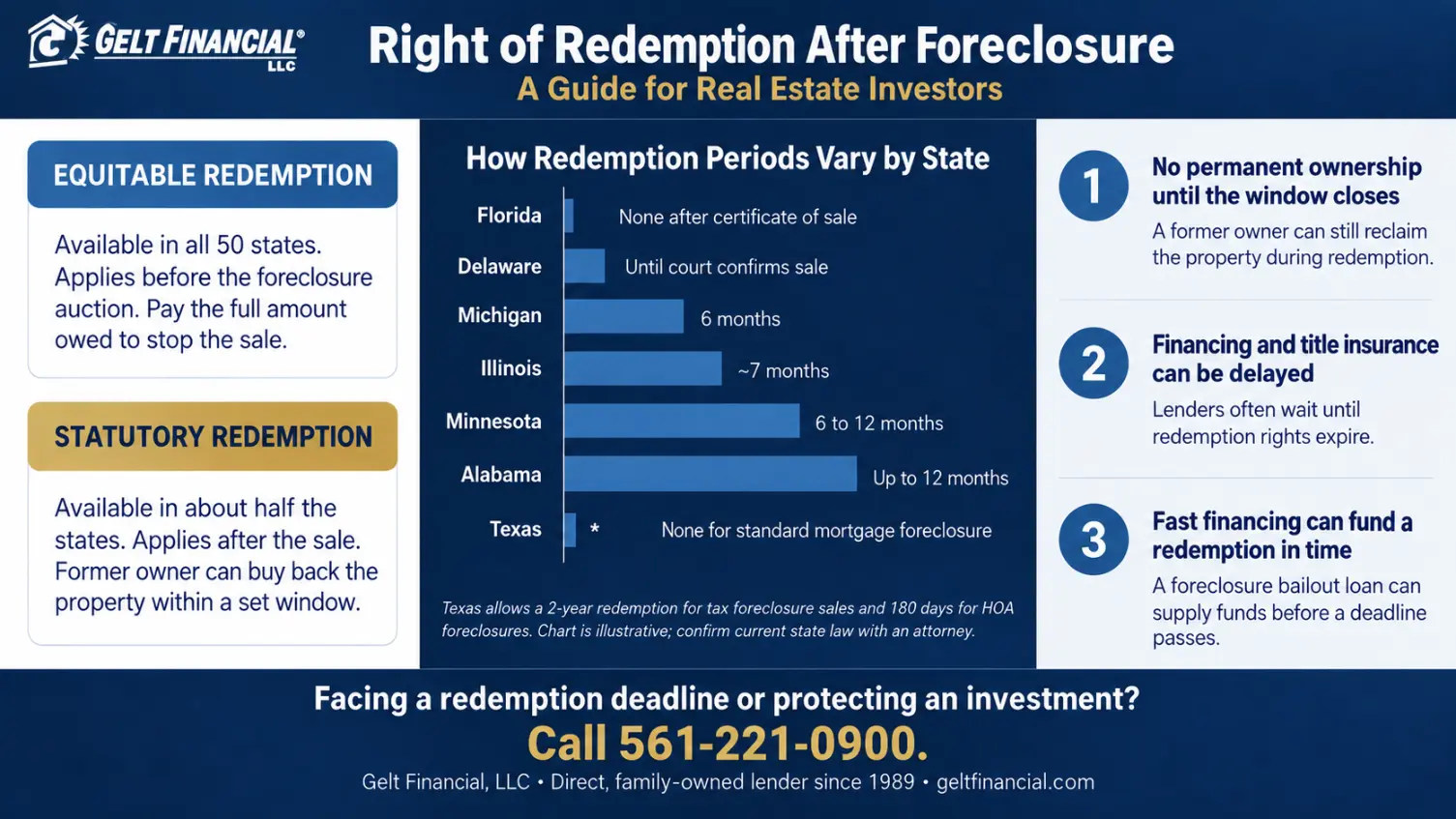
TL;DR: The right of redemption lets a former property owner reclaim a foreclosed home, either before the sale through equitable redemption, available in every state, or after the sale through statutory redemption, available in roughly half of the states for a set time period. For real estate investors, the state where a property sits determines how much risk comes with a winning bid at a foreclosure auction.
Understanding foreclosure laws around redemption matters just as much for investors buying distressed property as it does for the former property owner trying to hold onto it. Redemption rights vary depending on the state, the type of foreclosure, and even the property type, so what looks like a clean win at auction can come with strings attached.
What Is the Difference Between Equitable and Statutory Redemption in a Foreclosure Sale?
Every state recognizes equitable redemption. This is the legal right a property owner has to stop a foreclosure sale by paying the full amount owed, including fees and interest, any time before the auction happens. Once mortgage payments fall behind, this right gives the owner or borrower a path to pay what is due and return to good standing before the foreclosure process reaches the sale, whether the security instrument is a mortgage or deed of trust.
Statutory redemption is different. It only exists in states where the legislature created it by law, and it applies after the sale, not before. Redemption laws can differ between judicial and nonjudicial foreclosures depending on state statutes. Where it exists, a former owner can buy the property back from the purchaser within a defined time period by paying the winning bid amount, plus interest and allowable costs.
If the sale brings in less than the amount owed, a deficiency judgment may still be possible under state law.
Which States Have a Statutory Right of Redemption?
Redemption rules vary widely from state to state, and the table below gives a general sense of that range; for example, California gives borrowers one year before sale, showing how much these rules can differ by state. This list isn’t exhaustive, and an experienced real estate attorney should confirm current rules before anyone relies on this for an actual deal.
| State | Approximate Redemption Period | Notes |
|---|---|---|
| Alabama | Up to 1 year | Applies broadly after a foreclosure sale |
| Michigan | 6 months | Shorter if the property is abandoned |
| Minnesota | 6 to 12 months | Longer for agricultural or homestead property |
| Illinois | 7 months after service, or 3 months after judgment | Whichever period is longer |
| Delaware | Until the court confirms the sale | Narrow window tied to confirmation |
| Florida | None after the certificate of sale is filed | Redemption ends once the clerk files the certificate |
| Texas | No general right after a standard mortgage foreclosure | Redemption applies only to tax foreclosure sales and HOA foreclosure sales |
In California, the redemption period lasts one year before sale.
Texas is worth calling out on its own, since under Texas law the requirements depending on property type and sale type are different. A standard mortgage foreclosure carries no general redemption right at all. But a tax foreclosure sale is different. A former owner of a homestead or agricultural property gets a two-year right of redemption, while commercial property gets 180 days. An HOA foreclosure sale carries its own separate 180-day redemption right. Three different foreclosure procedures, three different outcomes, all in the same state.
Why Does This Matter for Real Estate Investors?

An investor who wins a foreclosure auction in a state with statutory redemption doesn’t walk away with permanent ownership right away. Until that time period runs out, the former owner retains a legal right to reclaim the property by paying the winning bid plus costs. That uncertainty affects resale timing, insurance, and how much a real estate investor is willing to spend on repairs to the house before the window closes, since major renovations during the redemption period are risky and improvement costs may not be recoverable if homeowners redeem. Foreclosed properties are often sold as is, without seller disclosures, which means potential buyers need to be more diligent. If the property is not redeemed, lenders may later sell similar assets as REOs, which can influence how investors compare opportunities in the market.
Can a Redemption Period Affect Title Insurance or Financing?
Yes. Most lenders and title insurance companies won’t fully insure or finance a property until any redemption period has run its course. An investor holding a property through that window can end up with capital tied up and no clean way to refinance or sell until the deadline passes.
How Does a Property Owner Redeem a Property?
The process typically starts with a written demand to the purchaser, requesting an itemized statement of what’s owed to reclaim the property. From there, the former owner has to come up with the full amount, the winning bid plus interest and allowable costs, within the deadline set by state law. Miss that date, and the legal ability to redeem disappears for good.
This is also where sheriff sale timelines and post-foreclosure or pre-foreclosure planning start to overlap, because pre-foreclosure begins with a missed mortgage payment notice and early contact can matter for homeowners weighing their options. The foreclosure process often starts around 3-6 months after missed payments, though timing varies by state and lender. A property owner working through financial hardship needs to know exactly which deadline applies, exactly how much money it takes to regain possession, and that most homeowners do not have much time once the process advances. In many counties, foreclosure auctions or sheriff sales occur weekly, so deadlines can arrive quickly once the process advances.
Can a Foreclosure Bailout Loan Fund a Redemption?

Yes, in states offering a statutory redemption period. A foreclosure bailout loan can supply the funds needed to redeem a foreclosed property, since approval is based on equity rather than a lengthy loan process, and timing matters just as much here as it does before an auction. We’re a family-owned, direct lender, and we give borrowers an honest answer fast, whether a borrower is trying to meet a deadline weeks away or days away.
Working against a redemption deadline and need funding fast? Call us at 561-221-0900 to talk through your options, or contact us to discuss timing and funding with our attorneys or an experienced real estate attorney.
Key Takeaways
- Equitable redemption exists in every state and only applies before the sale
- Statutory redemption exists in roughly half of states and applies after the sale
- Redemption periods typically run 30 days to a year where they exist, with requirements depending on state law and property type, changing both timing and cost
- Texas offers no general redemption after a standard mortgage foreclosure, but does provide limited rights in tax foreclosures and HOA foreclosures
- A foreclosure bailout loan can fund a redemption when time is short
Frequently Asked Questions
Does Florida have a right of redemption after foreclosure?
Florida’s redemption right ends once the clerk files the certificate of sale, which usually happens the same day as the auction or the next business day, leaving a very short window compared to other states.
How much does it cost to redeem a foreclosed property?
Costs typically include the winning bid amount plus taxes, interest, and allowable fees, though the exact formula and any redemption premium vary depending on state law.
Can unpaid taxes lead to foreclosure and redemption issues?
Yes. Unpaid property taxes can trigger tax foreclosure, and any excess proceeds from the sale may be claimable by the former owner depending on state law.
Can an investor lose a property they bought at auction?
Yes, if the state offers statutory redemption and the former owner pays the required amount before the deadline, the investor can be required to return the property. That risk can make potential buyers more cautious, especially since foreclosed homes are often sold as-is without seller disclosures.
Is the right of redemption the same in every state?
No. Roughly half of states offer statutory redemption after a sale, and the length, cost, and rules differ significantly from state to state.
What happens if the redemption period expires?
Once the deadline passes, the former owner permanently loses the legal ability to reclaim the property, and possession and title are generally no longer subject to the former owner’s redemption rights.
Are there alternatives before foreclosure?
In some cases, homeowners may consider short sales or other workout options before losing the property.
Facing a redemption deadline or need to protect an investment? Call us at 561-221-0900 today! Gelt Financial is ready to discuss your financing needs for commercial or investment real estate.