Early Loan Payoff & the Prepaid Interest Split

How a Bridge Loan Closed at 10.5% Delivered a 16% Effective Yield — and What That Means for Investors
Overview
This case study examines a real bridge loan originated by Gelt Financial, LLC that paid off significantly ahead of schedule. Thanks to a minimum interest provision with the borrower and a negotiated 50/50 prepaid interest split, the investors’ effective annualized yield jumped from a projected 10.5% to approximately 16%. We walk through the mechanics of how that happened, the genuine benefits it created, and the real tradeoffs that investors should understand.
Loan Summary
Background: What Is a Minimum Interest Provision?
In bridge and hard money lending, a minimum interest clause — sometimes called a guaranteed interest floor or prepayment provision — requires the borrower to pay interest for a minimum number of months, regardless of when they actually pay off the loan.
In this loan, that minimum was 9 months. The borrower understood at closing that if they paid off in month 3, month 5, or month 8, they were still on the hook for interest through month 9. It is disclosed, negotiated, and documented in the note — not a hidden penalty.
Why do borrowers accept it? Because private bridge capital offers something conventional lenders can’t: speed, flexibility, and a willingness to lend on assets or situations that banks won’t touch. The minimum interest provision is part of the cost of that access.
In this particular deal, the parties also agreed to a 50/50 prepaid interest split — a borrower-friendly modification that allows the borrower to recapture half of any unused interest if they pay off early, while the lender retains the other half. Both sides have skin in the game, and both sides benefit from a clean, early exit.
What Happened
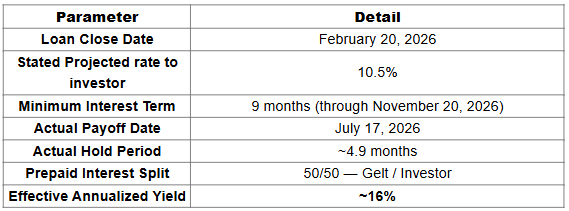
The loan closed February 20, 2026. The borrower paid off in full on July 17, 2026 — roughly 4 months and 27 days into a loan with a 9-month minimum interest commitment.
At payoff, the borrower still owed interest for the remaining window: approximately 4 months and 3 days (July 17 through November 20, 2026). Under the 50/50 split, Gelt retained half of that prepaid interest — roughly 2 months of additional interest income — collected in full at the closing of the payoff.
The Yield Math
Interest earned on actual hold (~4.9 months):
Reflects the 10.5% stated rate
Prepaid interest retained (50% of ~4.1 months):
~2 additional months of income
Total income equivalent:
~6.9 months on a ~4.9-month hold
Effective annualized yield: ~16% — over 500 basis points above the stated rate
The loan documents worked exactly as written. No modification, no dispute, no extension. The provision simply did its job.
The Benefits of an Early Payoff

1. Accelerated income, compressed into a shorter hold. The lender collected roughly 6.9 months of economic value on a loan outstanding for less than 5 months. When prepaid interest is retained, the investor earns more per day of capital deployed than the stated rate would suggest.
2. Capital returns faster — and can be redeployed. An early payoff frees up capital ahead of schedule. For a revolving private credit operation, that means returned principal can be put back to work in a new loan — compounding the income effect. If the next loan also earns 10.5%+, the total annual return on that capital can be meaningfully above what a single static loan would produce.
3. Credit risk is extinguished early. Every day a loan is outstanding is a day something can go wrong. An early payoff eliminates that tail risk cleanly. The lender gets paid, the collateral is released, and the file is closed. From a credit quality standpoint, an early payoff in good standing is the best possible outcome.
4. It validates the underwrite. A borrower who pays off early — particularly one who executes a sale, refinance, or business plan ahead of schedule — is a borrower whose project succeeded. Early payoffs in this context are a signal of strong origination and borrower selection.
5. Documentation discipline pays off. This yield enhancement required a minimum interest provision that was clearly drafted, properly disclosed, and reflected accurately in the note. Lenders who shortcut their documentation don’t get to collect prepaid interest. At Gelt, this is a reminder of why legal precision matters at origination.
The Downsides of an Early Payoff

1. Reinvestment risk is real. When a loan pays off ahead of schedule, the lender faces an immediate question: where does this capital go next? If the pipeline is thin, rates have compressed, or the market has shifted, returned principal may sit idle before it’s redeployed. The prepaid interest income helps offset this — but it doesn’t eliminate it.
2. The investor’s income stream is shorter than expected. Investors who depend on consistent monthly interest payments may find early payoffs disruptive. If a loan was expected to pay monthly interest for 9 months and it pays off at month 5, the investor receives a lump sum — not a continued stream. That lump sum may represent superior total return, but it doesn’t replace the cash flow rhythm some investors manage around.
3. Prepaid interest is a one-time event, not compounding income. The 16% effective yield on this deal reflects a single accelerated event. It cannot be sustained indefinitely. If all loans paid off in 5 months, the lender would need to originate nearly twice as many loans per year to maintain the same total income — a meaningful operational and pipeline demand.
4. The split works both ways. Under the 50/50 structure, the borrower retains half of the prepaid interest value. A full minimum interest provision — where the lender keeps 100% of unused interest — would have pushed the effective yield even higher. The borrower-friendly split is good for the lending relationship, but it is a real concession.
5. Not every early payoff has a minimum interest provision. Some loans are structured without prepayment protection. When a loan without a minimum interest clause pays off in month 5 of a 12-month expected term, the lender simply earns less than projected. The yield enhancement illustrated here is a function of the documentation, not an automatic feature of private lending.
What This Means for the Loan Pool

Gelt Financial’s pooled lending vehicle targets 10.5% annualized returns to accredited investors. That target is based on the stated rates of underlying loans, underwritten conservatively.
Events like this one — an early payoff with prepaid interest — represent what we call positive yield variance. They occur periodically across a portfolio. They are not budgeted, not guaranteed, and not uniform. But in a well-run private credit portfolio with properly documented minimum interest provisions, they should trend in one direction: upward.
When a loan in the pool generates above-target yield, that income is distributed to investors proportionally. The benefit doesn’t disappear into overhead. It flows through.
Conclusion
The loan: Closed February 20, 2026. Paid off July 17, 2026.
The structure: 9-month minimum interest, 50/50 prepaid interest split.
The result: Stated yield of 10.5%. Effective yield of approximately 16%.
Early payoffs are not universally good or bad for lenders and investors. They compress yield and return capital ahead of schedule — a genuine advantage. They also cut short a reliable income stream and create reinvestment pressure — a genuine challenge. The difference between an early payoff that hurts and one that helps often comes down to a single factor: whether the loan documents say what they’re supposed to say.
In this case, they did.