
Note-on-Note Financing for Private Lenders and Note Buyers
Note-on-note financing is one of the most powerful advanced strategies private lenders, note buyers, and real estate funds use to scale a portfolio without selling their existing loans.
At Gelt Financial, we have provided honest, family-owned note-on-note financing since 1989, helping over 10,000 clients access capital across 38 states with no hidden fees. Whether you are funding performing notes, non-performing notes, or building a private debt fund, our note-on-note financing program gives investors flexible leverage that fits any strategy.


What Is Note-on-Note Financing?
Note-on-note financing, also called loan-on-loan financing or lender finance, is a form of private lending in which one lender provides a loan to another lender.
The collateral is the underlying mortgage note and deed of trust, not the real estate directly.
In simple terms, if you own a mortgage note, you can pledge it to a loan lender and obtain capital against it. This frees up cash and keeps your note portfolio working while you originate more loans or acquire new positions.
A note-on-note lender typically advances 50 to 80 percent of the underlying note balance. The exact advance rate depends on the collateral strength, the borrower behind the note, the property type, and the payment history. For background on how mortgage notes work as legal instruments, see this Investopedia overview of promissory notes.
Want to walk through a specific scenario? Call us at 561-221-0900 today! Gelt Financial is ready to discuss your financing needs on commercial or investment real estate.
How Does Note-on-Note Financing Work?
The process is straightforward. Here is how a typical note on note transaction flows from start to closing:
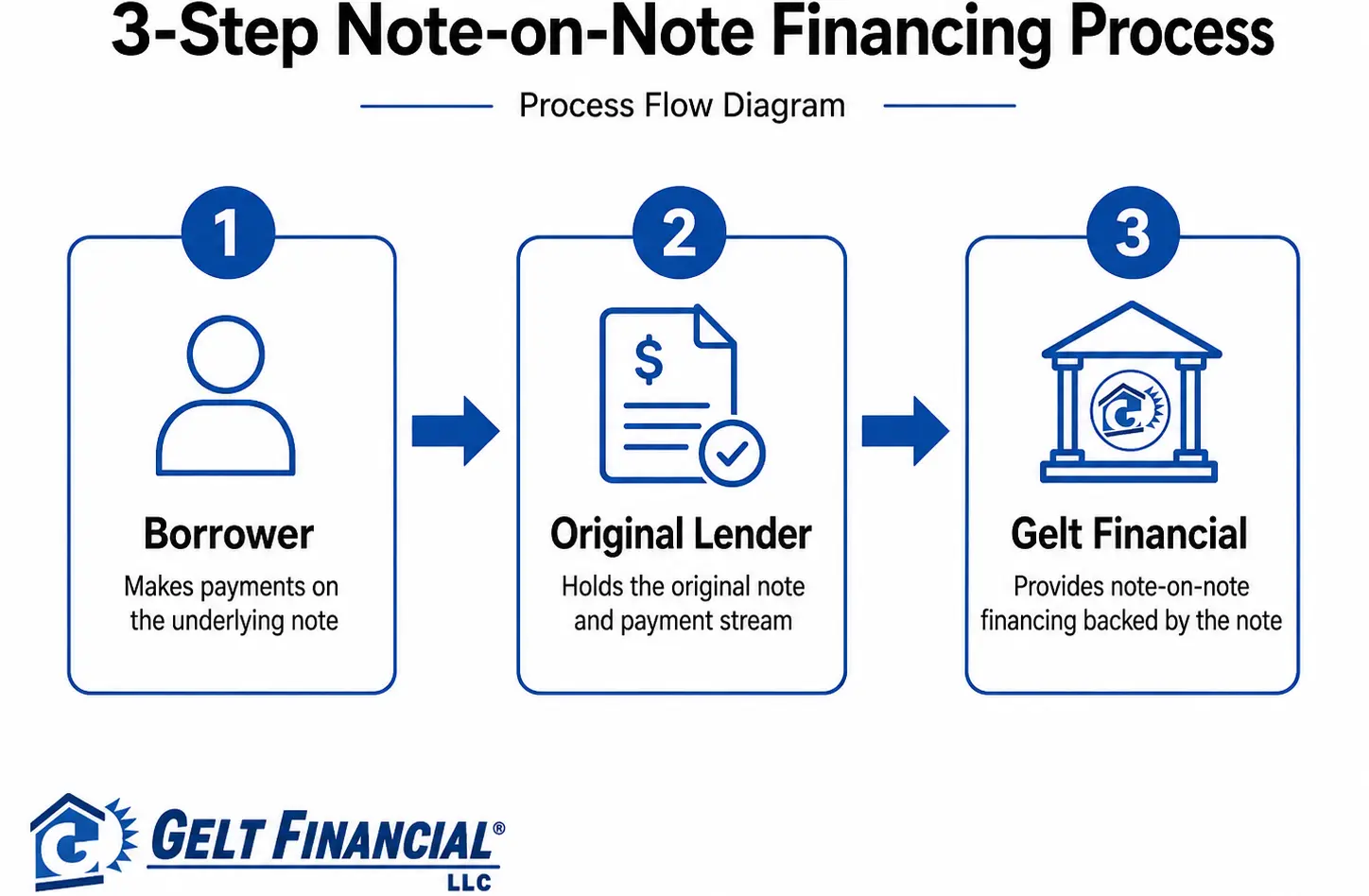
- A private lender, note investor, or developer originates or buys a mortgage note secured by real estate.
- They approach Gelt Financial seeking a note-on-note financing against that note.
- We underwrite the underlying borrower, the property, the title, the deed, and the payment history.
- We provide a loan secured by a collateral assignment of the note and mortgage.
- The original lender uses the funds to fund more loans, acquire additional notes, or invest in new projects.
- Payments on the underlying note service our financing through closing payoff or refinance.
If the underlying borrower defaults, we can step into the original lender’s position through a collateral assignment and pursue foreclosure if needed. This structure gives both sides certainty and clear execution. interest only.
A Worked Example of Note-on-Note Financing
Here is a complete example with real numbers so you can evaluate the strategy with confidence.
Assuming a private lender named ABC Capital originates a $1,000,000 first lien loan secured by a Florida investment property worth $1,400,000. The borrower has equity, is current, and the note pays 11 percent interest only.
ABC Capital wants to scale its lending business and obtain capital to fund more loans. They approach Gelt Financial as a loan-on-loan lender. Gelt evaluates the note with appropriate diligence and offers a 70% advance rate at 12% interest.
Here is the math:
- Underlying note balance: $1,000,000
- Property value: $1,400,000
- Underlying note interest rate: 11 percent
- Gelt advance rate: 70 percent
- Gelt loan amount to ABC Capital: $700,000
- Gelt interest rate: 9 percent
- ABC Capital’s monthly income from borrowers: $9,167
- ABC Capital monthly payment to Gelt: $5,250
- Net monthly income to ABC Capital: $3,917

ABC Capital keeps the $300,000 equity slice in the note plus a 2 percent yield spread on the leveraged portion. They free up $700,000 in cash to originate more loans. This is how lenders scale a portfolio with note-on-note financing while protecting their downside.

Who Uses Note-on-Note Financing?
Our note-on-note financing clients are sophisticated lenders and investors who need capital to scale. They include:
- Private lenders and hard money lenders are growing their loan portfolios
- Note buyers are acquiring performing and non-performing notes at a discount
- Private debt funds seeking leverage on existing loans
- Family offices and high-net-worth investors managing real estate credit
- Real estate developers are funding adjacent construction loan strategies
- Specialty lenders financing bridge or transitional commercial real estate
- LLCs, LPs, corporations, and trusts holding note assets
Entity borrowers are welcome. We work with LLCs, limited partnerships, S corporations, C corporations, Delaware statutory trusts, and family office structures. Personal name borrowers can also qualify when the structure supports it.
What Types of Notes Can We Finance?
Gelt Financial finances a wide pool of mortgage notes secured by real estate. Common forms include:
- Performing notes where the borrower is current
- Sub-performing notes where payments are late but equity remains
- Non-performing notes in default or foreclosure
- Distressed mortgage notes acquired from banks, the FDIC, or other lenders
- Commercial real estate notes on retail, office, industrial, and mixed-use properties
- Residential mortgage notes on single-family homes and small multifamily homes
- Construction loan notes and partially funded development positions
- Bridge loan notes and short-term transitional debt
We evaluate every note on its own merits. Banks regularly sell distressed loans at significant discounts through the FDIC loan sale program, and we routinely finance investors who acquire those pools.

Note-on-Note Financing vs Other Lending Options
Here is how note-on-note financing compares to other ways a private lender can access capital, scale, or exit a position.
Table 1: Note-on-Note Financing vs Other Capital Sources
| Feature | Note on Note Financing | Bank Warehouse Line | Selling the Note |
|---|---|---|---|
| Keep the note? | Yes | Yes | No |
| Speed to closing | Days to weeks | Months | Weeks |
| Advance rate | 50 to 80 percent | 60 to 85 percent | Sale price varies |
| Approval focus | Note quality and collateral | Lender financials and pool | Buyer demand |
| Flexibility | High | Low | Moderate |
| One-off transactions | Welcome | Often not allowed | Welcome |
| Best for | Single notes and small pools | Large programmatic lenders | Exiting a position |
Table 2: Performing vs Non-Performing Note Financing Terms
| Term | Performing Note | Sub-Performing Note | Non-Performing Note |
|---|---|---|---|
| Advance rate | 65 to 80 percent | 55 to 70 percent | 40 to 60 percent |
| Interest rate | Lower rate | Mid range | Higher |
| Closing time | 7 to 14 days | 10 to 21 days | 14 to 30 days |
| Diligence depth | Standard | Moderate | Deep |
| Typical use | Yield leverage | Workout strategy | Acquire and foreclose |
Table 3: Gelt Financial vs Traditional Lenders
| Category | Gelt Financial | Traditional Bank Lender Finance |
|---|---|---|
| Minimum loan size | Flexible | Often $20 million plus |
| Underwriting time | Days | 30 to 60 days |
| One-off deals | Yes | Rare |
| Family owned | Yes | No |
| Direct access to decision makers | Yes | No |
| Honest, plain language terms | Yes | Varies |
For most small and mid-market private lenders, note-on-note financing through a family-owned shop is the most flexible path. You keep your note, keep your yield spread, and obtain capital fast.
How Does Gelt Financial Structure Note-on-Note Loans?
Every note on a note financing transaction we close is custom-built. We do not force borrowers into a rigid box. Here is what we typically consider when structuring:
- Loan amount sized to the note balance, property value, and underlying borrower strength
- Advance rate or loan-to-value is generally 50 to 80 percent of the note balance
- A term that is short, often matched to the underlying note maturity
- Interest rate is priced based on the risk and quality of the asset
- Recourse or non-recourse, depending on the structure
- Closing time is often measured in days when documentation is complete
- One-off transaction or revolving structure, depending on the client’s plan
Our honest, family-owned approach means we tell clients yes or no quickly. No drawn-out process. No hidden fees. No surprises at closing.

Underwriting Deep Dive: What We Look For
When you seek note-on-note financing from Gelt, we underwrite with the same care we apply to our own balance sheet. Here is what we evaluate.
Documents We Need
- The original promissory note and all allonges
- The recorded mortgage or deed of trust
- The title policy and the current title search
- The complete payment history and servicing records
- The underlying borrower’s loan file
- The current appraisal or broker price opinion
- The assignment chain shows a clear title to the note
- Entity documents for LLCs, corps, or trusts
- Any forbearance agreements, modifications, or workouts
What We Evaluate
- Quality of the underlying borrower and payment record
- Equity cushion in the underlying property
- Property type, location, and market conditions
- Legal enforceability of the note and lien position
- Clean assignment chain and recorded interests
- Exit strategy of the note holder
Red Flags and Deal Killers
Some scenarios we cannot finance. These include broken assignment chains, missing original notes, undisclosed junior liens that wipe out collateral, properties with significant title defects, and notes with usurious or unenforceable terms. We will walk you through any concerns honestly so you can fix them or move on.
Three Note-on-Note Financing Case Studies
Real scenarios show how the strategy works in practice. Names and numbers are illustrative composites of typical Gelt transactions.

Case Study 1
Florida Note Buyer Acquires Bank Pool
A Florida investor purchases a pool of three non-performing notes from a regional bank for $1.2 million. The face value is $2.1 million. Gelt provides $720,000 in note-on-note financing at 60 percent advance, allowing the buyer to keep cash on hand for foreclosure costs. Two notes reperform within six months. The third proceeds through foreclosure, and the property sells at auction for full recovery.

Case Study 2
Texas Private Lender Scales Portfolio
A Texas private lender holds $4 million in performing notes on investment properties. They want to fund more loans without raising additional capital from investors. Gelt provides a $2.8 million note-on-note facility at a 70 percent advance. The lender uses the capital to originate eight new loans over the following year, doubling their fee income and yield spread.

Case Study 3
California Family Office Bridge Strategy
A California family office acquires a sub-performing note secured by a commercial real estate asset undergoing repositioning. Gelt provides note-on-note financing during the workout period. When the underlying borrower refinances 11 months later, the family office pays Gelt off and books a 19 percent annualized return on the leveraged position.
What Are the Risks of Note-on-Note Financing?
Honest lending means talking openly about risk. Note-on-note financing is a powerful tool, but it is not for everyone. Here are the main risks to evaluate before you commit.
- Underlying borrower default. If the underlying borrower stops paying, the note holder is still responsible for payments to Gelt. Reserves matter.
- Collateral value decline. A drop in the property value reduces recovery in foreclosure. Conservative loan-to-value protects against this.
- Legal and title risk. Broken assignment chains or title defects can stall enforcement. Proper diligence at closing prevents most problems.
- Time risk. Foreclosure can take months or years, depending on the state. Plan for it.
- Yield compression. Leverage amplifies returns but also amplifies losses if the strategy fails.
We help clients evaluate every risk before closing. That is how we have stayed in business for over three decades.
Why Choose Gelt Financial for Note-on-Note Financing?
We have been a private lender since 1989. Over the years, we have closed over 10,000 transactions across 38 states. We are still family-owned. We still answer the phone when you call.
What sets us apart:
- We buy and finance notes ourselves, so we understand both sides of the table
- We close notes on note financing in days when documents are in order
- We offer honest, plain language terms with no hidden fees
- We work with first-time note buyers and experienced private debt funds alike
- We say yes to scenarios that other lenders pass on, including one-off transactions
You can pair note-on-note financing with our bridge loans, hard money loans, debtor-in-possession financing, or single-family residence investment lending when a transaction needs more than one layer of capital.

States Where We Provide Note-on-Note Financing
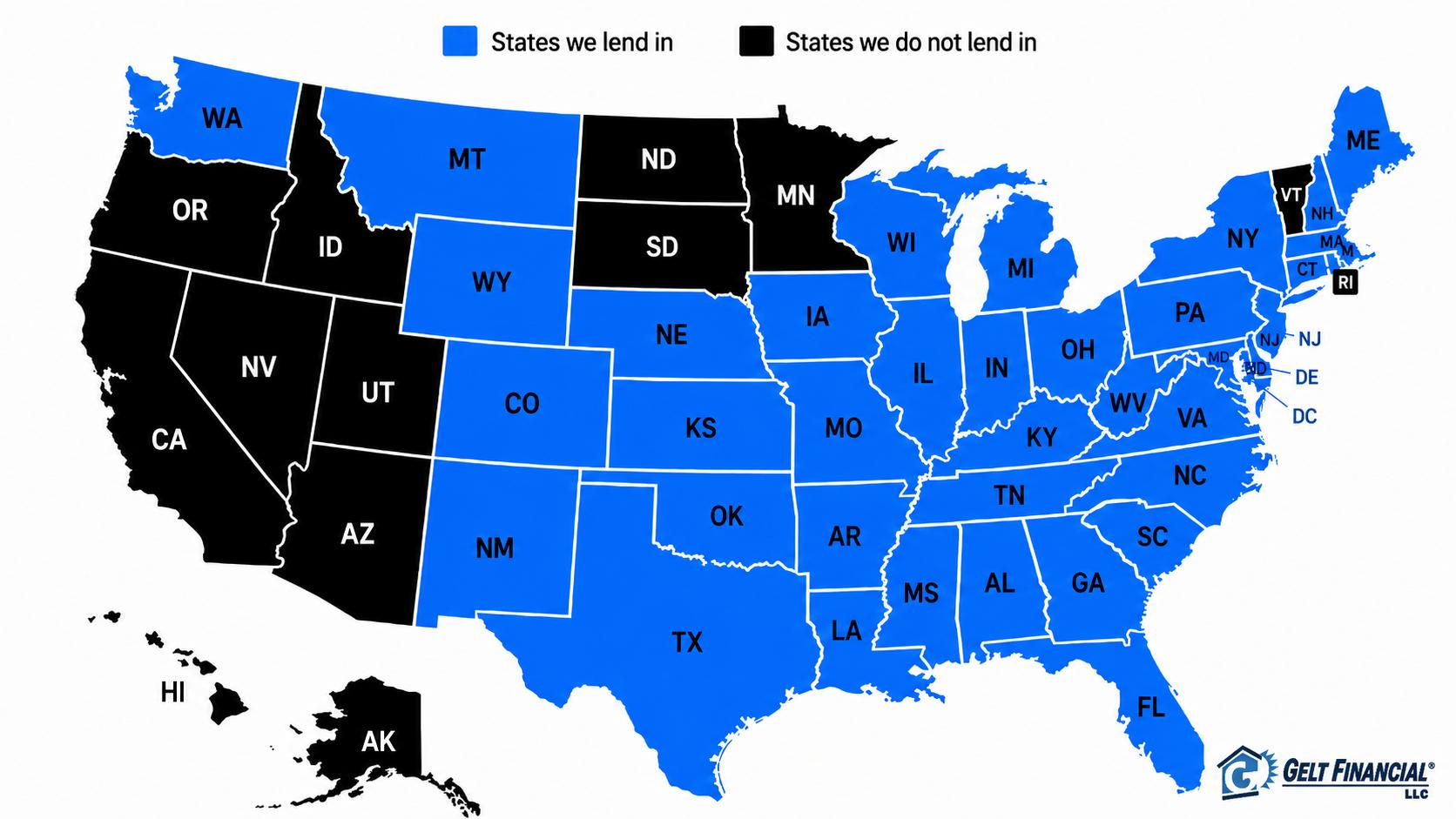
Gelt Financial lends in 38 states across the United States. Demand is strongest in Florida, Texas, New York, Georgia, North Carolina, Pennsylvania, New Jersey, Ohio, and Illinois, but we routinely close transactions across the country. If you are not sure whether we lend in your state, call us and ask. The answer is usually yes.
Key Takeaways
- Note-on-note financing is a loan secured by an existing mortgage note and deed, not by the property itself.
- It is used by private lenders, note buyers, debt funds, family offices, and developers seeking to access capital.
- Gelt Financial has been a family-owned, honest lender since 1989, with over 10,000 closed transactions.
- We finance performing, sub-performing, and non-performing notes on commercial real estate and investment properties.
- Advance rates run from 50 to 80 percent of the note balance, depending on quality.
- We close in days, not weeks, with no hidden fees.
Frequently Asked Questions
Glossary of Note-on-Note Financing Terms
- Advance Rate: The percentage of the underlying note balance that the loan-on-loan lender will fund.
- Assignment of Note and Mortgage: A legal document transferring the rights of a note to a new holder, used as collateral in note-on-note financing.
- Collateral Assignment: A pledge of the note as security without a full sale of the asset.
- Collateralized: Backed by a specific asset, in this case, a mortgage note.
- Deed of Trust: A recorded instrument securing the note against real property in many states.
- Distressed Debt: Notes where the borrower has defaulted or is otherwise in financial trouble.
- Lender Finance: An umbrella term for any financing extended to a lender, including note-on-note loans.
- Loan on Loan: A common alternative name for note on note financing.
- Non-Performing Note: A note where the borrower is 90 days or more delinquent.
- Performing Note: A note where the borrower is current and paying as agreed.
- Sub-Performing Note: A note with sporadic or late payments but not yet in default.
- Yield Spread: The difference between the interest rate on the underlying note and the rate paid on the note on note loan.
Ready to Discuss Your Note-on-Note Financing?
Gelt Financial has been funding honest, family-owned private mortgage solutions since 1989. If you are a private lender, note buyer, fund manager, or developer looking to scale, note-on-note financing may be the solution you need. Visit our apply now page or browse our deals done to see how we work.
Call us at 561-221-0900 today! Gelt Financial is ready to discuss your financing needs for commercial or investment real estate.