Hard Money Loan Requirements 2026: Credit, LTV, Experience, Reserves

Hard money loan requirements in 2026 come down to a short list of key factors: the borrower’s credit score, loan-to-value, real estate investing experience, and cash reserves, plus the property, the numbers, and the exit strategy.
TL, DR: What are the hard money loan requirements for 2026?
Hard money loan requirements 2026 are mostly property-focused underwriting, not personal income-based underwriting like traditional lenders and conventional mortgages. Most hard money lenders focus on the investment property, loan-to-value, loan amount, purchase price, down payment, your cash reserves, and whether the exit strategy makes sense for real estate investors.
Contact us for a quick pre-check, and we’ll let you know if your deal qualifies for hard money lending before you waste time.
Why do hard money loan requirements feel strict in 2026?
Real estate investors lose deals when traditional bank and mortgage loans move too slowly, or when conventional financing imposes strict debt-to-income ratios, income verification, and longer loan approval timelines.
That delay can trigger higher closing costs, extended holding time, missed inspection windows, and messy renegotiations that change loan terms and interest rates.
Hard money loans work as a financing tool when you need speed and flexibility, but you must submit the right loan structure and a clean financing structure that matches what hard money lenders finance.
What do hard money lenders actually underwrite in 2026?
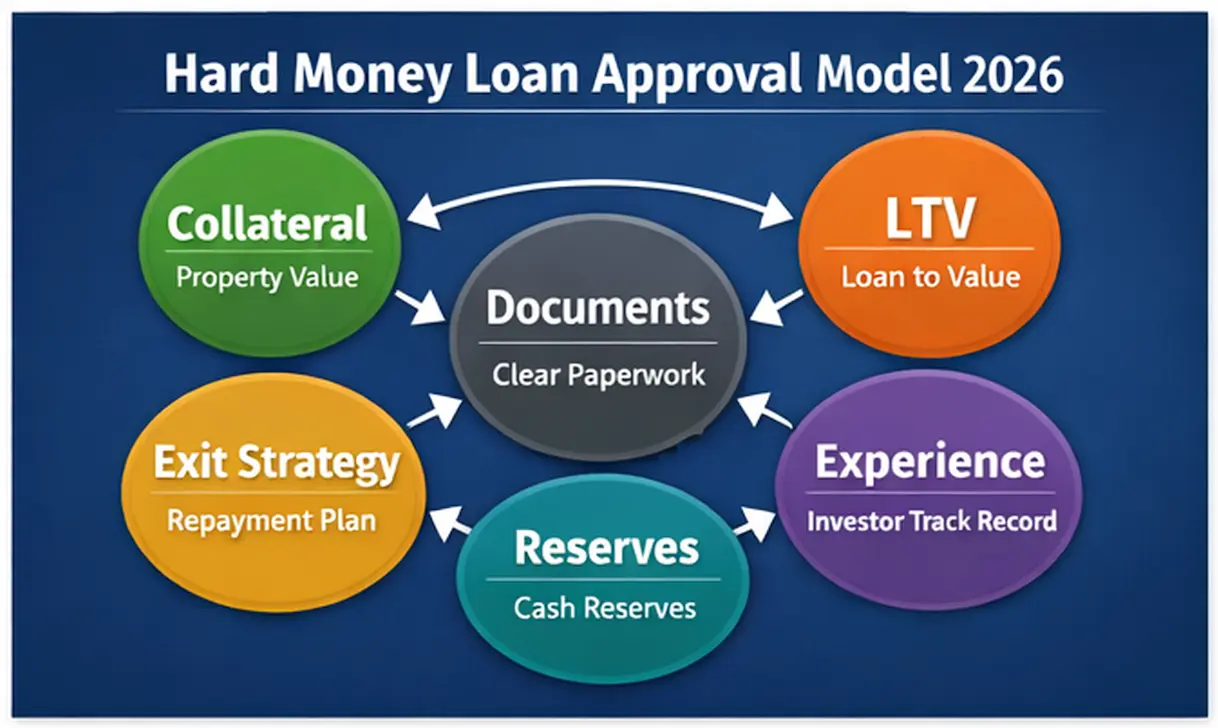
Most lenders, including private lenders and private investors, make decisions using a simple approval model. If you align your loan package with these five factors, you will secure financing faster and reduce back-and-forth with the loan officer.
- Collateral and the property’s current value, or after repair value when applicable
- Leverage, loan-to-value, down payment, and the equity cushion
- Exit strategy: how the loan money gets repaid on time
- Borrower capacity, real estate investing experience, and cash reserves
- Execution risk, title, insurance, construction plan, and timeline
What credit score do hard money lenders require in 2026?
Many hard money lenders review the borrower’s credit score, but hard money lenders focus more on collateral, loan-to-value, and the borrower’s financial profile than traditional mortgages do. Some programs have a minimum credit score, while others allow lower credit scores when the deal has strong equity, strong cash flow potential, and verified cash reserves. Unlike conventional lending, hard money financing often reduces the weight of debt-to-income ratios and personal income, especially when the loan is asset-based, and the investment strategy is clear.
What do most hard money lenders look for in a credit profile?
- Payment patterns, recent late payments matter more than old mistakes
- Major credit events and how recent they are
- Tradelines that show consistent loan payment behavior
- Overall stability of the borrower’s financial profile
What can offset a weaker credit score with many hard money lenders?
- Larger down payment and lower loan-to-value
- Strong bank statements showing liquidity and reserves
- A clear exit strategy and realistic timeline
- A clean valuation story for the real estate
What LTV is typical for hard money loans in 2026, and how is it calculated?

Loan-to-value is the loan amount divided by the property value, and it directly controls risk for hard money lenders and private lenders. For purchases, value often starts at the purchase price and is supported by comps, then the lender confirms what the property is worth in its current condition. For renovations, after-repair value (ARV) may be considered, but many lenders still cap exposure to keep financing options safe. A lower LTV usually yields more favorable loan terms, while a higher LTV often requires a larger down payment or stronger reserves.
Common loan-to-value ranges by scenario-
| Scenario | Typical loan-to-value | What improves terms | Common deal killers |
|---|---|---|---|
| Purchase of investment property | 60% to 75% of the current value | Strong comps, clean title, larger down payment | Inflated purchase price, weak comps |
| Refinance of rental property | 60% to 70% of the current value | Clear payoff, strong reserves, stable plan | Title issues, unclear lien order |
| Cash out refinance | 50% to 65% of the value | Lower leverage, strong exit strategy | Aggressive cash out, thin reserves |
| Renovation or after-repair value scenario | Conservative ARV exposure | Detailed scope, credible budget, clear timeline | Vague scope, inflated after repair value |
What experience do hard money lenders want in 2026?
Experience is how lenders assess execution risk, especially in fix-and-flip projects, construction loans, and repositioning plans. Fix-and-flip investors with documented project history often move faster through loan approval because lenders can see that the borrower can manage scope, contractors, and timelines. First-time real estate investors can still qualify, but the right loan structure usually requires a conservative loan-to-value ratio, stronger cash reserves, and a simpler financing structure.
Experience signals that matter to many lenders-
- Completed projects or proven portfolio growth
- A credible GC or contractor plan, with bids tied to line items
- A realistic schedule that matches the scope of work
- A clean investment strategy and exit strategy that fits the market
Experience proof checklist-
- Prior project list and outcomes
- Settlement statements when available
- Before and after photos for completed work
- Contractor bid and scope of work tied to budget line items
- Short summary of real estate investing experience relevant to this deal
What reserves do hard money lenders require, and why do they matter?

Cash reserves are your post-close liquidity, and they prove you can carry the investment property if timelines slip. Many hard money lenders and private lenders view reserves as protection against missed deadlines, insurance surprises, and changes in interest rates. In traditional financing, lenders lean on income verification, personal income, and debt-to-income ratios, but in hard money lending, bank statements and verified liquidity often matter more.
What counts as reserves for most lenders
- Bank statements showing liquid cash reserves
- Brokerage accounts that can be verified
- Proof of funds with clear ownership
- Documented funds that can cover closing costs and early loan payments
Carry costs that keep running between milestones and approvals
- Interest-only payments or standard interest payments
- Insurance
- Utilities
- Taxes and HOA dues, when applicable
What property types qualify for hard money in 2026?
Hard money lenders finance a wide range of real estate, but they still want assets that can be valued and sold if needed. Investment property eligibility depends on marketability, condition, and the cleanliness of the title and valuation story.
Common property types
- Investment property, 1 to 4 unit residential
- Rental property, including single-family and small multifamily
- Mixed-use and small balance commercial in many markets
- Select construction loans depending on the scope and sponsor strength
Common red flags that slow loan approval
- Title issues, liens, ownership gaps
- Unpermitted work or zoning complications
- Hard-to-comp locations where valuation support is weak
- Insurance challenges that delay closing
What documents do hard money lenders require for approval and closing?
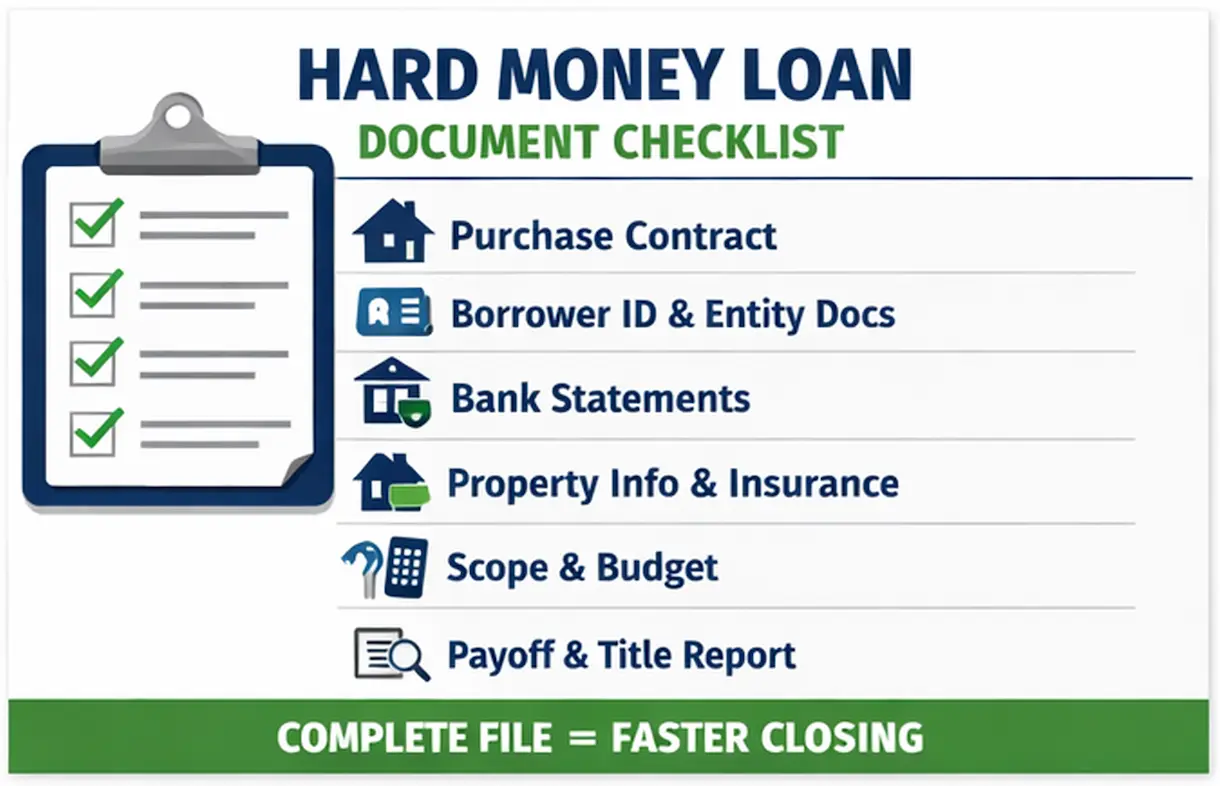
This is where the right hard money lender stands out: good processes and in-house coordination can reduce friction. A clean document package reduces underwriting conditions, shortens the closing timeline, and improves your chance of favorable loan terms.
Document checklist to close faster-
| Category | Examples | Why it matters | Common mistakes |
|---|---|---|---|
| Deal basics | Purchase contract, addenda, escrow contract | Confirms purchase price and timing | Missing addenda, unsigned pages |
| Borrower identity | ID, entity docs, signing authority | Confirms borrower and structure | Entity mismatch, missing resolutions |
| Financials | Bank statements, proof of funds | Confirms reserves and capacity | Screenshots without ownership proof |
| Property info | Insurance quote, rent roll, leases | Supports risk and rental income | Insurance not ready, missing lease terms |
| Rehab package | Scope of work, contractor bid, and budget | Supports after-repair value logic | Vague scope, no line items |
| Refinance docs | Payoff statements, lien info | Confirms payoff and lien order | Missing payoff, stale statements |
| Title | Preliminary title, vesting details | Prevents closing surprises | Unresolved liens, unclear vesting |
How fast can hard money loans close in 2026, and what slows them down?
Hard money loans are designed for speed, but speed is earned with a clean loan agreement package and quick responses to conditions. Compared to traditional mortgage loans and conventional mortgages, you can often shorten the timeline because income verification is less stringent, and decisions rely more on collateral.
Most common bottlenecks-
- Valuation delays, weak comps, access problems
- Title issues and payoff statement delays
- Insurance binder delays that block closing
- Entity docs not ready, or signing authority unclear
- Scope and budget mismatch that triggers questions
Speed checklist that reduces closing friction-
- Provide a complete contract and escrow contract on day one
- Provide bank statements and proof of funds showing cash reserves
- Package scope, bid, and budget with matching line items
- Schedule access early for valuation or inspection
- Order insurance early with the correct lender clause language
- Clear title issues quickly, including liens and payoffs
Contact us for a quick review. We can tell you what is missing before it slows your loan approval.
What are the most common hard money loan denial reasons in 2026?

Most declines are not about one detail; they are about risk stacking. If multiple weak points show up at once, lenders pull back.
Common denial reasons-
- Weak equity or aggressive loan-to-value
- Unclear exit strategy or unrealistic timeline
- Valuation story does not match purchase price or comps
- Title issues and unresolved liens
- Insufficient cash reserves for closing costs and carry
- Poor execution plan on fix-and-flip or construction loans
- Slow borrower responses that break the closing window
What is the cleanest exit strategy for hard money in 2026?
Hard money is short-term financing, so the exit strategy is the backbone of the loan structure. Traditional lenders rely on long-term amortization and stable income verification, whereas hard money lenders seek a clear, timely path to repayment.
Common exits used in real estate investing-
- Sale of the real estate after stabilization or improvement
- Refinance into conventional financing or other traditional loans
- Hold as a rental property once income and cash flow support takeout financing
- Partner takeout, if documented and credible
Exit plan test checklist-
- If you plan to sell, is the pricing supported by comps and market-time buffers?
- If you plan to refinance, do you meet the likely underwriting and timing requirements?
- If you plan to rent, is rental income realistic, and are reserves sufficient for lease-up?
Call today for a free quote, and we’ll pressure-test your exit strategy and right loan structure.
How should you compare hard money lenders in 2026?
The best hard money lenders win on certainty, clarity, and process, not just a low headline rate. When you compare financing options, look beyond interest rates and ask how the lender handles valuation, title, and servicing.
Lender comparison checklist-
| Feature | Why it matters | What to ask | Red flag answer |
|---|---|---|---|
| Closing speed | Protects contract deadlines | “What is your typical timeline?” | Vague promises, no steps |
| Underwriting clarity | Avoids last-minute changes | “What are your key conditions?” | “We will see later.” |
| Valuation approach | Controls the loan amount | “How do you value the property?” | No clear method |
| Title process | Prevents closing delays | “How do you clear liens and payoffs?” | No process ownership |
| Loan terms | Impacts the total cost | “Interest-only payment options, extensions?” | Hidden fees and surprises |
| Communication | Reduces friction | “Who is my loan officer contact?” | Too many handoffs |
Bridge loans are often used as a short-term financing tool for time-sensitive acquisitions and transitions.
FAQ: Hard money loan requirements 2026
1) What credit score do you need for hard money in 2026?
Credit score expectations vary, and many hard money lenders look at the borrower’s credit score as one part of the borrower’s financial profile. Some lenders have a minimum credit score, but others accept lower credit scores when collateral is strong, LTV is conservative, and cash reserves are verified.
2) What loan-to-value do most hard money lenders offer in 2026?
Most hard money lenders set the loan-to-value based on the property’s current value and comps, with after-repair value used more cautiously when rehab is involved. Lower leverage often leads to more favorable loan terms, while higher leverage may require a larger down payment, stronger reserves, or tighter loan terms.
3) Do you need experience to get a hard money loan?
Not always, but real estate investing experience can improve approval speed and structure. First-time borrowers can still qualify when the investment property is straightforward, leverage is lower, the scope is clear, and bank statements show adequate liquidity and cash reserves to cover closing costs and early loan payments.
4) How much cash reserves do you need for a hard money loan?
Reserve requirements vary by lender and deal, but most lenders require a clear cash buffer after closing. Plan for enough reserves to cover interest-only payments or standard loan payments, insurance, utilities, and taxes during the expected timeline, plus a safety cushion.
5) What documents speed up hard money loan approval the most?
The fastest approvals usually come from a complete contract package, strong value support, and clean financial proof. Submit bank statements showing reserves, insurance readiness, entity docs if applicable, and a clear scope and budget when repairs or construction loans are involved, all organized for easy review.
Next steps: Get approved faster with hard money loan requirements 2026
If you want speed and certainty, treat your submission like a professional financing structure, not a casual email thread. The right hard money lender will still require the basics, but clean packaging can reduce conditions and keep closing on schedule.
- Bring conservative leverage, clear value support, and a realistic exit strategy
- Show cash reserves and a borrower’s financial profile that can handle delays
- Submit a complete document set to reduce closing friction and re-trades
Contact us to review your deal, or call today for a free quote, and Gelt Financial will help you align your loan structure with the key hard money loan requirements in 2026.