How Do Bridge Loans Work for Real Estate Investors? A Step-by-Step Timeline for 2026

TL;DR – How Bridge Loans Work (The 30-Second Answer)
A bridge loan is temporary financing that real estate investors use to acquire and renovate investment property before securing permanent financing or selling the property. Bridge loans work by providing immediate capital based on property value rather than the borrower’s credit score, with a 3-5 day closing and interest-only payments over 6-36 months, then repaying through a refinance to long-term financing or a property sale. Bridge financing typically costs 12% interest plus 3 points, requires a 35% down payment, and focuses on your clear exit strategy rather than income verification.
Key takeaways:
Short-term financing – Bridge loans typically run 6-36 months, not 15-30 years like traditional loans, serving as a temporary financing solution until you refinance or sell.
Fast approval process – Close in 3-5 days versus 30-45 days for bank loans, giving estate investors a competitive advantage in fast markets.
Asset-based lending – Private lenders evaluate property value and your viable exit strategy, not personal income or debt-to-income ratios.
Interest-only structure – Monthly payments cover only interest with a balloon payment at maturity, keeping cash flow manageable during renovations.
Three exit paths – Refinance to permanent financing (DSCR, conventional), sell the property, or request an extension if needed.
What Are Bridge Loans? (Definition for Real Estate Investors)
Bridge loans are short-term bridge loan products that “bridge” real estate investors from property acquisition to their planned exit strategy, whether that’s securing permanent financing after stabilization or selling after renovations. Think of bridge financing as your immediate funding tool when traditional mortgage lenders won’t touch a property or when you need quick access to capital in competitive markets.
Bridge Loans vs. a Traditional Mortgage
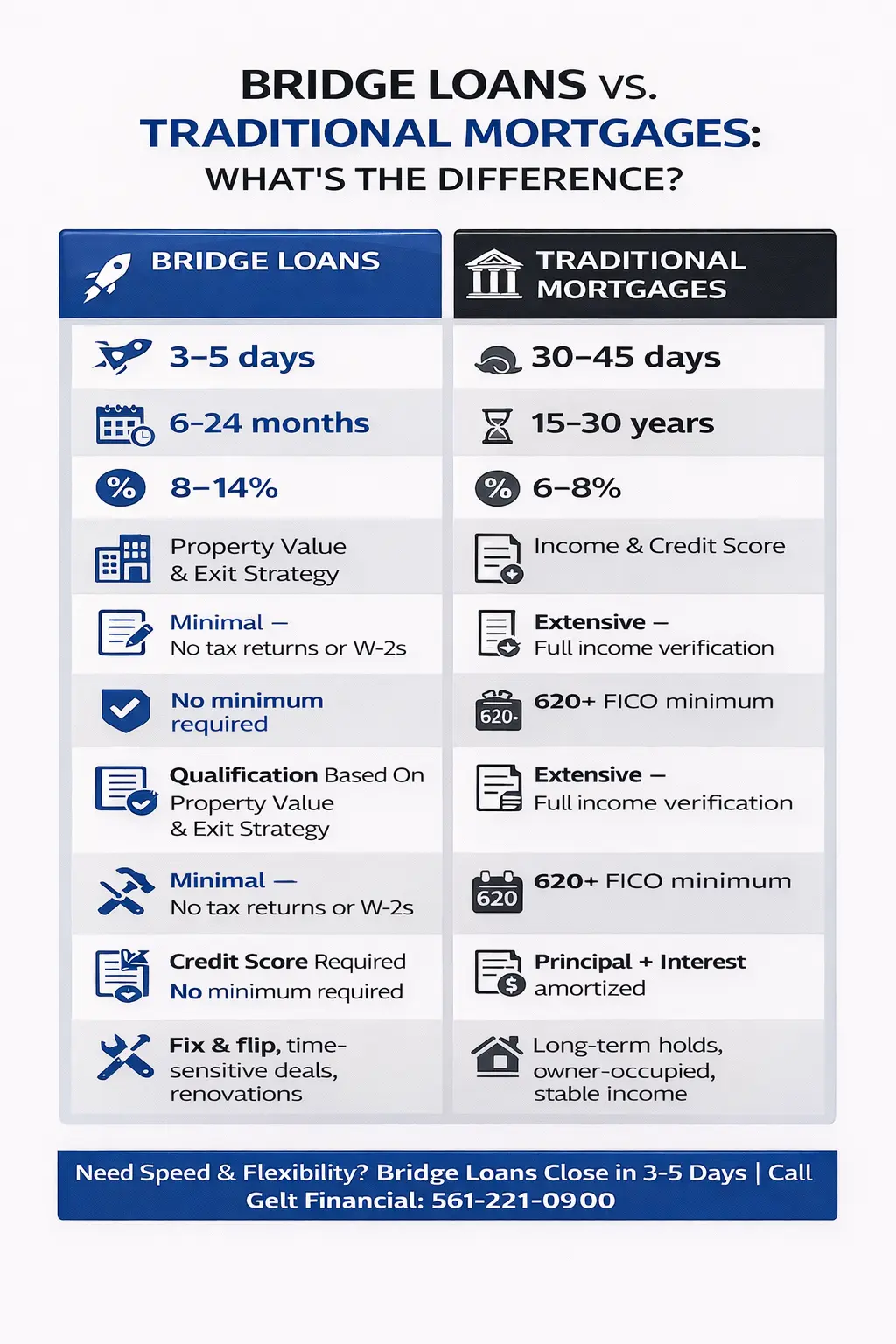
The term “bridge” refers to crossing from one financial position to another—from purchase to sale, or from acquisition to long-term financing. At Gelt Financial, we’ve structured over 10,500 bridge loans across 38 states, providing real estate investors with temporary financing that has enabled billions in successful real estate transactions that traditional loans couldn’t support.
Bridge loans work differently from conventional financing in critical ways. While traditional mortgage lenders scrutinize your borrower’s financial situation through tax returns, W-2s, and credit history, we evaluate the investment property itself—its current condition, after-repair value, and your exit strategy. While bank loans take 30-45 days to close with extensive documentation, our bridge loans close in 3-5 days with minimal paperwork. This speed makes all the difference when competing against cash buyers or acquiring properties at foreclosure auctions.
How Do Bridge Loans Work? The Complete Mechanics
The Basic Bridge Loan Structure
Bridge loans are typically secured by real estate in a first-lien position, meaning we hold the primary claim if something goes wrong. The loan amount is based on the loan-to-value ratio, usually 65% of the purchase price or after-repair value for renovation projects. This means you’ll provide a 35% down payment from your own funds or existing assets.
The loan term runs 6-36 months, depending on your project timeline: shorter for fix-and-flip projects, longer for rental property stabilization before refinancing. Most lenders, including Gelt Financial, structure these as interest-only loans, where you pay only the interest monthly, and the principal comes due as a lump-sum balloon payment at maturity, when you execute your borrower’s exit strategy.
Here’s how the money flows: You apply with property details and your business plan. We evaluate property value using comparable sales; no formal appraisal is needed. We agree on terms (interest rates, points, closing costs). The title work confirms clean ownership. At closing, funds are disbursed, and you take possession. During the bridge period, you make interest-only payments while avoiding normal mortgage payments and still executing your plan. At maturity, you pay off the bridge loan through sale proceeds or a new loan from refinancing.
How Lenders Evaluate Bridge Loans
Unlike financial institutions that focus on your borrower’s credit score and income documentation, we use property-focused underwriting examining:
Property fundamentals – Type (single-family, multi-family, commercial), condition, location, market strength, and realistic after-repair value based on comparable sales.
Your exit strategy – Clear, viable exit strategy showing how you’ll repay. Will you sell after renovations? Refinance to DSCR once rental income is stabilized? Portfolio refinance after accumulating multiple properties?
Project feasibility – Realistic renovation costs, reasonable timeline, experienced contractors, and sufficient cash reserves to complete the plan.
Your experience – First deal or seasoned investor (both can qualify, but experience affects terms).
Market conditions – Local real estate market strength, buyer demand, rental rates, and days on market for comparable properties.
The Bridge Loan Timeline: Complete Step-by-Step Process
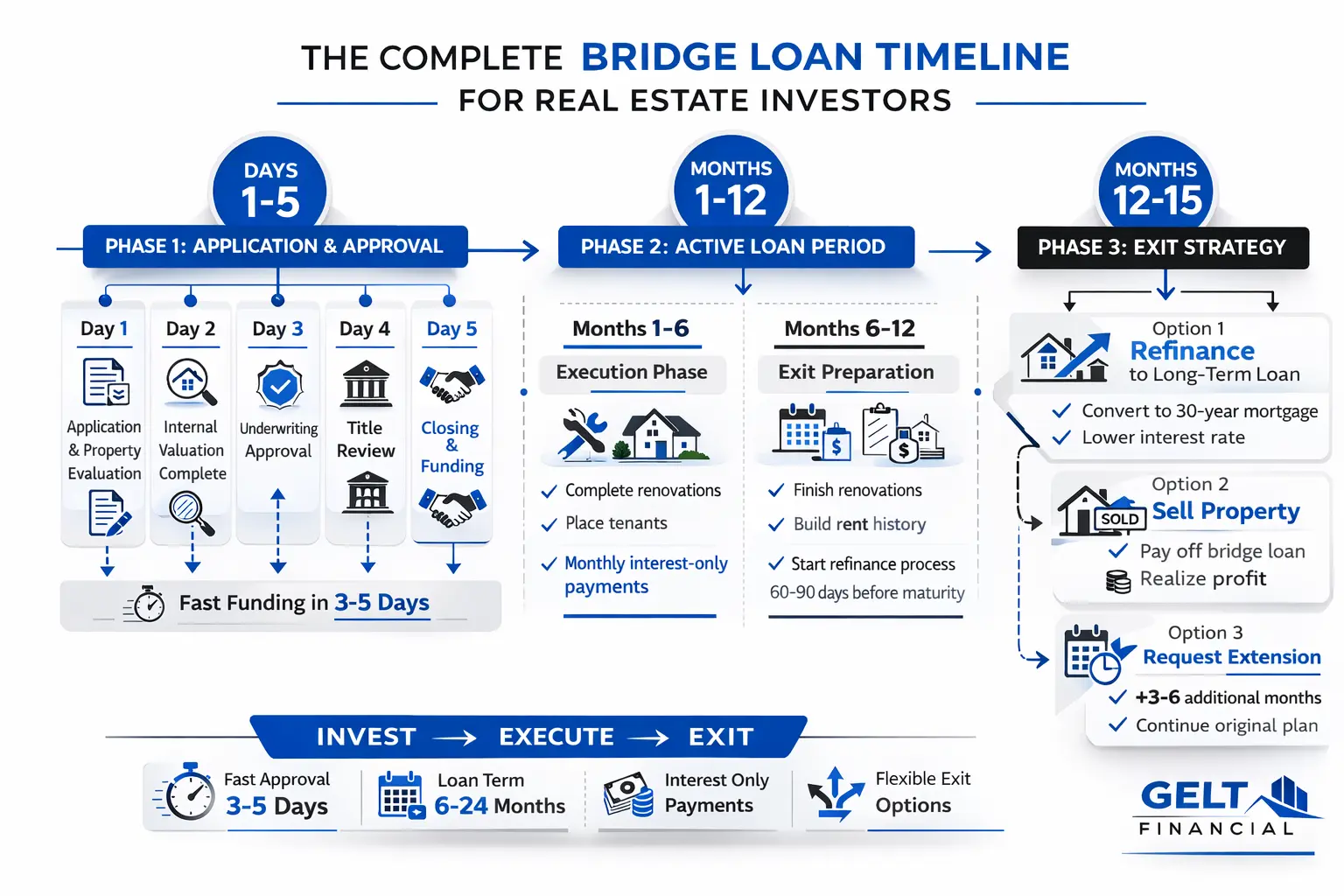
Phase 1: Application & Approval (Days 1-5)
| Day | Activity | What Happens | What You Provide |
|---|---|---|---|
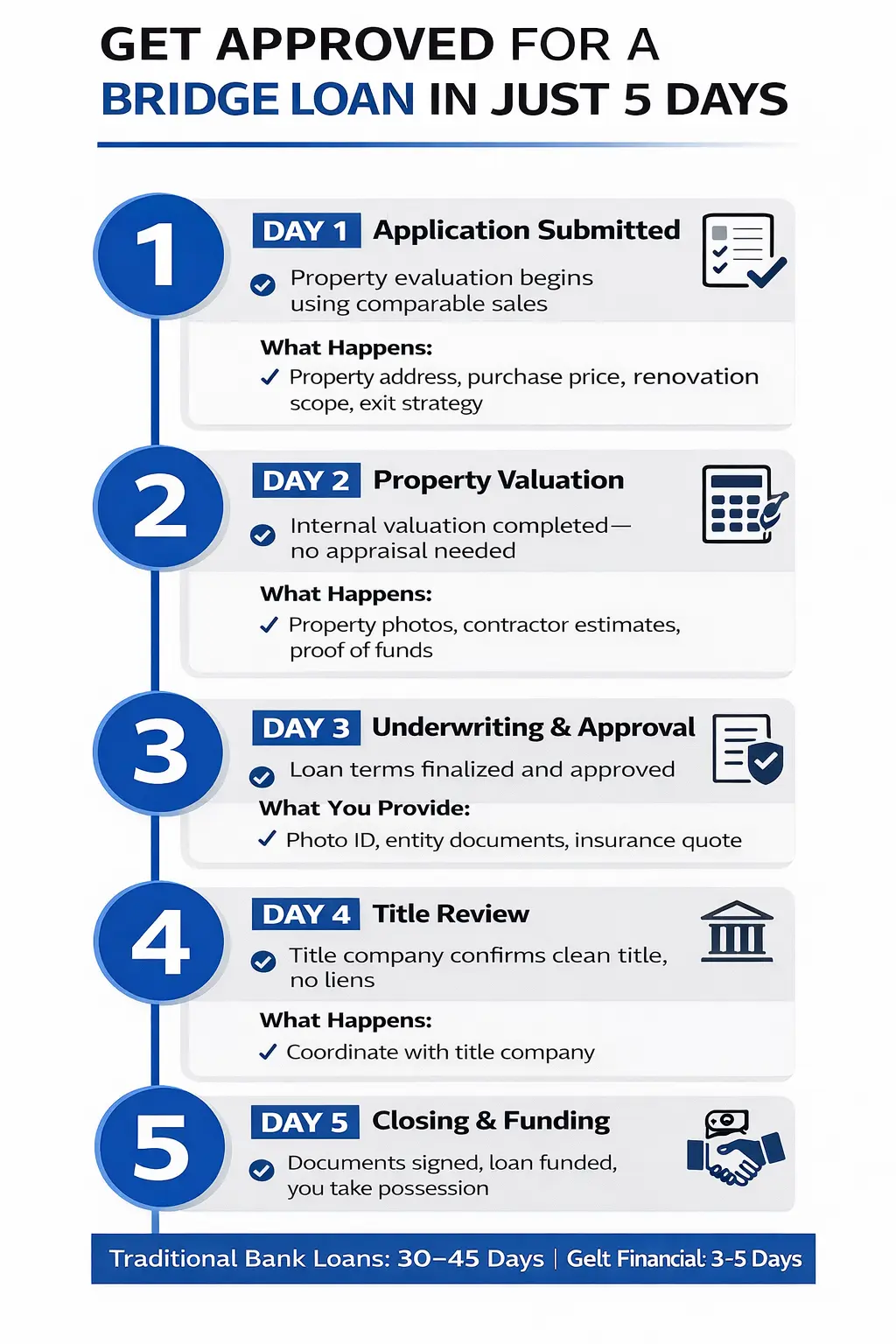
| Day 1 | Application submitted | We evaluate property using comparable sales and market data | Property address, purchase price, renovation scope, exit strategy, proof of down payment funds |
| Day 1-2 | Property valuation | Internal valuation completed—no appraisal delays | Property photos, contractor estimates, and a business plan showing profit potential |
| Day 2-3 | Underwriting approval | We approve loan terms based on property value and your exit strategy | Photo ID, entity documents if using LLC, and insurance quote |
| Day 3-4 | Title review | Title company confirms a clean title, no liens or judgments | Coordinate with the title company (they handle this) |
| Day 4-5 | Closing & funding | Documents signed, down payment wired, loan funded | Sign closing documents, wire down payment to escrow, and receive keys |
Phase 2: Active Loan Period (Months 1-12+)
Months 1-6: Execution Phase
- Complete renovation work (for fix and flip)
- Place quality tenants (for rental properties)
- Make monthly interest-only payments to maintain the loan
- Document all progress, expenses, and timeline
- Monitor market conditions for optimal exit timing
Months 6-12: Exit Preparation Phase
- Finish all renovations and punch list items
- For refinancing: accumulate 6-12 months rent payment history, build cash reserves, contact long-term financing lenders
- For selling: stage property, list with an agent, begin marketing
- Start the exit process 60-90 days before loan maturity and never wait until the last minute
Phase 3: Exit Strategy Execution (Months 12-15)
Exit Option 1: Refinance to Permanent Financing – Most investors acquiring rental properties use bridge financing as a temporary solution, then refinance to DSCR or conventional financing once the property generates stable cash flow. This exit requires 6-12 months of documented rental income, a debt service coverage ratio of 1.25+, and cash reserves equal to 6-12 months of PITI.
Exit Option 2: Property Sale- Fix-and-flip investors renovate during the bridge period, then list and sell for profit. Sale proceeds pay off the bridge loan at closing. This works best when renovation costs are accurately estimated, and market conditions support your target sale price.
Exit Option 3: Extension- Sometimes you need more time. At Gelt Financial, we offer extensions if you’re making progress on your original exit strategy. Extensions cost less than rushing a bad sale or accepting unfavorable refinance terms.
Bridge Loan Requirements: What You Need to Qualify

Minimum Qualification Criteria
Property requirements – Must be investment property (not owner-occupied primary residence), located in a fundable market (we lend in 38 states), and have realistic value supporting your loan request.
Down payment – 35% of purchase price from your payment funds, verified through bank statements or existing property equity.
Exit strategy – Clear, written plan showing how you’ll repay the short-term loan through sale, refinance, or other viable path.
Insurance – Property insurance with the lender listed as the mortgagee.
What you DON’T need – No minimum credit score, no income verification, no tax returns, no employment verification, no private mortgage insurance, no debt-to-income calculations that traditional mortgages require.
Documentation Checklist
✅ Property details – Address, purchase contract, photos
✅ Down payment proof – Bank statements showing available funds
✅ Renovation budget – Scope of work, contractor bids (for renovation projects)
✅ Exit strategy – Written plan with timeline and numbers
✅ Photo ID – Driver’s license
✅ Entity documents – LLC operating agreement if applicable
✅ Insurance – Property insurance quote
Bridge Loan Costs: Rates, Points, and Fees
Interest Rates and Payment Structure
Bridge financing typically carries interest rates of 12% or more in 2026, higher than traditional loans but justified by the speed and flexibility it offers. Your specific rate depends on loan-to-value (lower LTV = lower rate), property type, your experience level, and the clarity of your exit strategy.
Interest-only payments keep monthly costs manageable. On a $200,000 bridge loan at 10% interest, you pay $1,667 monthly interest-only versus $1,755+ principal and interest on a traditional mortgage. This preserves cash flow during renovations, when the property isn’t yet generating income.
Upfront Costs
Origination points: 2-3 points (2-3% of loan amount) paid at closing
Processing fees: $500-$1,500 for underwriting
Closing costs: Title insurance, escrow, and recording typically range from $2,000 to $4,000
Total example: $150,000 bridge loan = $3,000-$4,500 points + $2,500-$5,500 closing costs
Total Cost Analysis
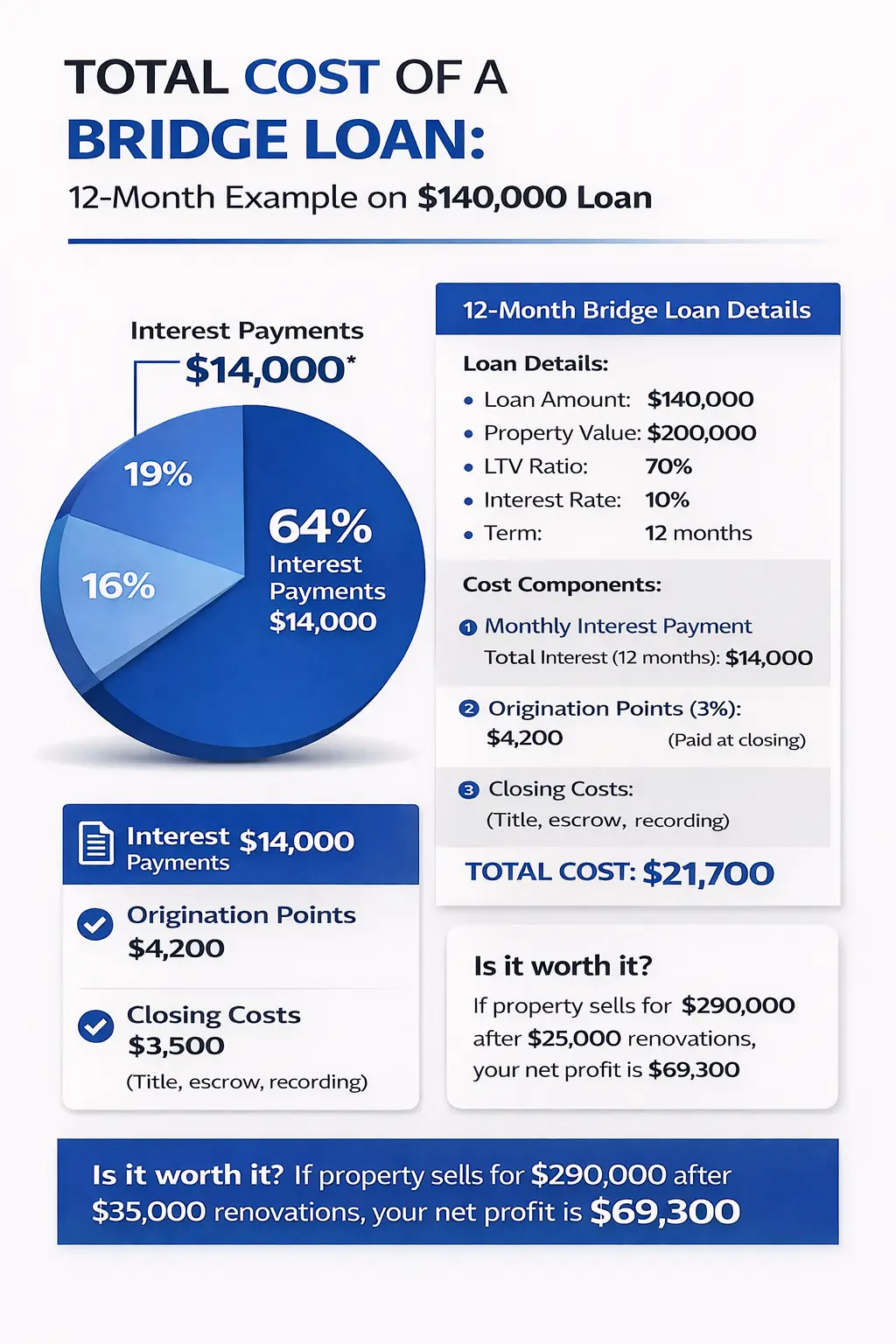
Example scenario:
- Property purchase: $200,000
- Bridge loan (70% LTV): $140,000
- Down payment: $60,000
- Rate: 10%, Term: 12 months, Points: 3%
Costs:
- Interest (12 months): $14,000
- Points: $4,200
- Closing costs: $3,500
- Total: $21,700
If this property sells for $290,000 after $35,000 in renovation costs, your profit is $69,300 after all costs, including the bridge loan. Higher interest rates on short-term financing enabled a deal that traditional mortgages couldn’t match.
Bridge Loan Use Cases: When to Use Bridge Financing

Fix and Flip Projects
Purchase distressed properties that traditional lenders won’t fund, complete renovations using your capital or construction loan, then sell for profit. Bridge loans give you immediate capital to acquire properties in competitive markets where sellers demand quick closings. Typical timeline: acquire in 5 days, renovate 3-6 months, list and sell months 6-10, pay off bridge loan from sale proceeds.
Rental Property Acquisition
Buy properties needing work, renovate to market standard, place tenants, build rent history, then refinance to DSCR or conventional long-term financing. This strategy uses temporary financing during the value-add phase, then transitions to permanent financing once the property is stabilized and generating positive cash flow.
Time-Sensitive Deals
Foreclosure auctions, estate sales, and off-market opportunities often require closing within days. Cash buyers dominate these situations, but a bridge loan from a direct lender like Gelt Financial provides cash-equivalent speed. When motivated sellers need to close fast, or you’re competing against multiple offers, traditional mortgage timelines lose deals.
Cash Flow Gaps Between Properties
Selling one investment property to fund the next creates timing problems. A bridge loan provides temporary financing to acquire the new property before your existing property closes, preventing you from losing deals due to cash flow gaps during your portfolio expansion.
Bridge Loans FAQs
How long does it take to get a bridge loan approved?
At Gelt Financial, we approve and fund bridge loans in 3-5 days from application to closing. This speed comes from being a direct lender with our own capital, using internal property valuations rather than formal appraisals, requiring no income verification, and offering a streamlined approval process with immediate access to decision-makers. Most lenders need 7-14 days; bank loans take 30-45 days minimum.
What credit score do I need for a bridge loan?
We don’t require a minimum credit score for bridge financing. Unlike traditional lenders, who decline borrowers with scores below 620-640, we evaluate your property value, down payment, and exit strategy. We’ve funded bridge loans for investors with credit scores from 450 to 800. Your borrower’s credit history may slightly affect interest rates, but it won’t disqualify you from approval.
What happens if I can’t pay off my bridge loan on time?
Contact us immediately before your loan matures to discuss extension options. We offer extensions if you’re making progress on your planned exit strategy. Extensions are far better than defaulting. We’d rather work with you to extend the loan term than foreclose; that’s expensive and time-consuming for everyone. Most investors who plan ahead and start their exit process early never need extensions.
Do bridge loans require an appraisal?
No. We use internal property valuations based on comparable sales, property photos, and 35+ years of real estate valuation experience. This eliminates the 2-3 week appraisal delay and $400-600 appraisal cost that slows traditional loans. Some bridge lenders may order broker price opinions for complex commercial properties, but formal appraisals are rare in bridge financing.
Can I use a bridge loan for owner-occupied properties?
Bridge loans are primarily for investment property, not owner-occupied primary residences. We focus on rental properties, fix-and-flip projects, and commercial real estate investments. If you need financing for your primary home, traditional mortgage products or home equity loans are better options. Bridge financing is a financial tool designed specifically for real estate investments.
What’s the difference between a bridge loan and a home equity line?
A bridge loan is short-term financing for property acquisition and renovation, typically secured by the property you’re purchasing. A home equity line of credit uses equity in your existing property as collateral to access funds. Residential and commercial bridge loans offer immediate capital for new purchases; home equity loans leverage existing assets. Bridge financing doesn’t require you to own another property first—just sufficient down payment funds.
How do I know if a bridge loan is right for my deal?
Use a bridge loan when you need quick access to capital (3-5 days), the property won’t qualify for traditional financing due to condition or other factors, you have a clear exit strategy within 6-24 months, you can provide a 25-35% down payment, and the profit potential justifies higher interest rates. If you have unlimited time, perfect credit, stable W-2 income, and the property is in excellent condition, conventional financing might cost less—but you’ll rarely find deals sitting around waiting 45 days for bank approvals.
Get Bridge Loan Approval in 3-5 Days with Gelt Financial
Most real estate investors lose profitable deals not from lack of opportunity, but from lack of speed when opportunities arise. Traditional mortgage lenders with 30-45 day approval timelines kill more deals than bad market timing ever could.
At Gelt Financial, we structure bridge loans specifically for real estate investors who need immediate funding, properties that financial institutions won’t touch, and flexible terms aligned with your borrower’s exit strategy.
Why we’re your best choice for bridge financing:
✅ 3-5 day closings – We close faster than any traditional lender, giving you a competitive advantage against cash buyers
✅ Direct lender, not broker – You talk to us, the decision-makers who approve and fund from our own capital
✅ No minimum credit score – We evaluate property value and exit strategy, not your credit history
✅ No appraisal delays – Internal valuations keep your timeline on track
✅ Flexible bridge loan terms – 6-24 month terms structured around your specific timeline
✅ 38 states, 10,500+ loans, 35+ years – We’ve funded every type of real estate investment strategy across virtually every market condition
✅ Interest-only payments – Manageable monthly costs during your project
✅ No income verification – No tax returns, W-2s, or employment verification required
Our bridge financing isn’t just temporary financing; it’s a strategic partnership private money loan with a private lender who understands real estate investments, respects aggressive timelines, and moves at the speed your deals demand.
Whether you’re pursuing fix-and-flip projects, acquiring rental properties, or need quick access to capital for time-sensitive opportunities, we structure and offer bridge loans that support your plan from acquisition through a successful exit.
Ready to close your next deal in 3-5 days?
Don’t let slow traditional loans cost you profitable real estate transactions. Start with a bridge loan lender who understands that in real estate investing, speed creates wealth.
Call Us Directly: 561-221-0900
We’re ready to discuss your property, walk you through how bridge loans work, and get you funded fast. No call centers, no brokers, just direct conversation with the people who can approve your loan and close in days, not weeks.