Bridge-to-DSCR in 2026: When to Refinance Your Hard Money Loan (Checklist + Timeline)
TL;DR – When Should You Refinance from Hard Money to DSCR (Debt Service Coverage Ratio)?

Refinance from your bridge loan to DSCR once your rental property has stabilized rental income for 6-12 months, achieved a debt service coverage ratio of at least 1.25, and your post-renovation appraisal supports a loan-to-value of 75% or less. Most real estate investors successfully transition to permanent financing between months 9 and 15 after acquisition.
Rental income is stabilized – Your investment property has been leased for 6+ months with documented payment history, and most lenders require a signed lease at market rent to ensure the property is rent-ready for refinancing. The property’s ability to generate income is the key factor in DSCR qualification; a strong cash flow, where your DSCR calculation shows income exceeds the mortgage payment by at least 25%, is essential.
Renovations are 100% complete – All rehab work is finished, the property is rent-ready, and the appraisal reflects market value that supports your refinance path to long-term loans.
Your bridge loan maturity is 60-90 days away – Start your refinance process 2-3 months before your short-term loan matures to avoid balloon payment stress or costly extensions.
You have 6-12 months of reserves – DSCR financing typically requires cash reserves equal to 6-12 months of PITI per property to demonstrate your borrowing capacity can handle vacancies. Many DSCR lenders also require a minimum ownership period of 6 to 12 months before you can refinance.
Refinancing at the right time not only secures long-term financing but can also free up equity for higher-return acquisitions.
What’s the Difference? Bridge Loan vs. DSCR Loan Explained
Understanding the fundamental difference between bridge loans and DSCR loans is critical for real estate investors building a sustainable exit strategy. These two financing options serve distinct purposes in your real estate investing journey.
Choosing the right financing option can save investors fees, lower risk, and maximize returns.
Bridge Loans (Hard Money Loans): The Short-Term Solution
Hard money loans are short-term, interest-only loans designed to provide quick funding for real estate investments.
Bridge loans are short-term loans designed to help investors acquire and renovate investment property quickly. Think of bridge funding as your “get in fast” capital that focuses on the property’s potential value, not your personal income or tax returns.
These loans are asset-based, meaning lenders evaluate the property’s ability to generate future income or to appreciate after renovations. Bridge loans typically come with higher interest rates than conventional mortgage products, but they offer unmatched speed and flexibility that traditional lenders cannot match.
Typical use cases include:
Fix-and-flip projects – Purchase distressed properties, complete renovations within 6-12 months, then either sell for profit or refinance into permanent financing.
Time-sensitive acquisitions – When you need to close quickly on a deal, bridge loans provide the speed advantage.
Properties not yet rent-ready – Traditional lenders won’t touch properties that need substantial repairs, but hard money lenders fund based on the after-repair value.
Self-employed investors with income verification challenges – If your tax returns don’t tell the whole story of your income potential, bridge loans bypass the income documentation maze.
Average bridge loan terms run 6-24 months with interest rates typically ranging from 8-14%. Most investors pay interest-only monthly payments, with the principal due as a balloon payment at maturity or upon refinance.
Cross-collateralized or blanket loans, which allow you to use multiple properties as security, are generally not ideal for first-time investors. These financing options are better suited for experienced investors looking to scale quickly.
Gelt Financial closes hard money loans in 3-5 days, giving investors the competitive edge needed in fast-moving markets. With no minimum credit score required and flexible underwriting based on the deal itself, we structure bridge funding that sets you up for a smooth refinance path when your property is stabilized.
DSCR Loans: The Long-Term Rental Property Play

DSCR loans (Debt Service Coverage Ratio loans) are investor-focused products designed for stabilized properties that generate consistent rental income. Unlike conventional mortgages, which scrutinize your personal income, DSCR financing evaluates whether the property’s rental income can cover the mortgage payment and operating expenses. DSCR loans are approved based on the property’s rental income, not the borrower’s personal income, allowing investors to qualify based purely on the property’s cash flow potential.
The debt service coverage ratio is calculated using this formula:
DSCR = Net Operating Income ÷ Total Debt Service
Example: Your rental property generates $2,500 monthly in market rent. After you reduce expenses like property taxes, insurance, and HOA fees (totaling $500), your net operating income is $2,000 monthly. Your proposed mortgage payment is $1,600 per month.
DSCR = $2,000 ÷ $1,600 = 1.25
A minimum DSCR of 1.25 means your property cash flow exceeds debt obligations by 25%, providing the healthy cushion lenders require.
Why real estate investors refinance into DSCR:
Sustainable financing for long-term rentals – DSCR loan terms typically run 30 years with fixed rate options, replacing the ticking clock of bridge loans.
Portfolio growth without income constraints – DSCR lenders don’t count your existing rental debt against your debt-to-income ratio the way Fannie Mae or conventional mortgage lenders do. Investors can use DSCR loans to scale their portfolios without the traditional limits imposed by conventional lenders.
No tax return or income verification hassles – Whether you’re self-employed, have complex finances, or prefer privacy, DSCR loans eliminate the personal income documentation that traditional lenders demand.
Cash out refinance opportunities – Once your property has seasoned and appreciated, DSCR programs allow you to pull equity for your next deal while maintaining strong cash flow.
DSCR loans typically offer loan-to-value ratios up to 75-80%, with interest rates currently ranging from 7-10%. The right loan for long-term wealth building through real estate is often a DSCR product.
Quick Comparison Table
| Feature | Bridge Loans (Hard Money) | DSCR Loans |
|---|---|---|
| Loan Term Length | 6-24 months (short-term loans) | 15-30 years (long-term loans) |
| Approval Speed | Same day (Gelt Financial standard) | Same day (Gelt Financial standard) |
| Credit Requirements | Flexible; no minimum score | 620-660+ for best rates |
| Income Verification | None required | Property income only (no personal income docs) |
| LTV (Loan-to-Value) | Up to 65-75% | Up to 75-80% |
| Interest Rates | Varies | Varies |
| Best Use Case | Acquisition, fix and flip, renovations | Stabilized rental properties, long-term rentals, portfolio growth |
| Monthly Payment | Interest-only with balloon payment | Principal + Interest (fixed rate available) |
| Qualification Focus | Property’s potential value | Property’s rental income and net operating income |
| Prepayment Penalties | Rare | Common (1-5 years) |
| Down Payment | 25-35% | 20-25% |
The smart exit strategy for most investors? Start with bridge funding to acquire and renovate, then refinance into DSCR financing once the property generates consistent income.
The Bridge-to-DSCR Refinance Timeline: Your Month-by-Month Roadmap
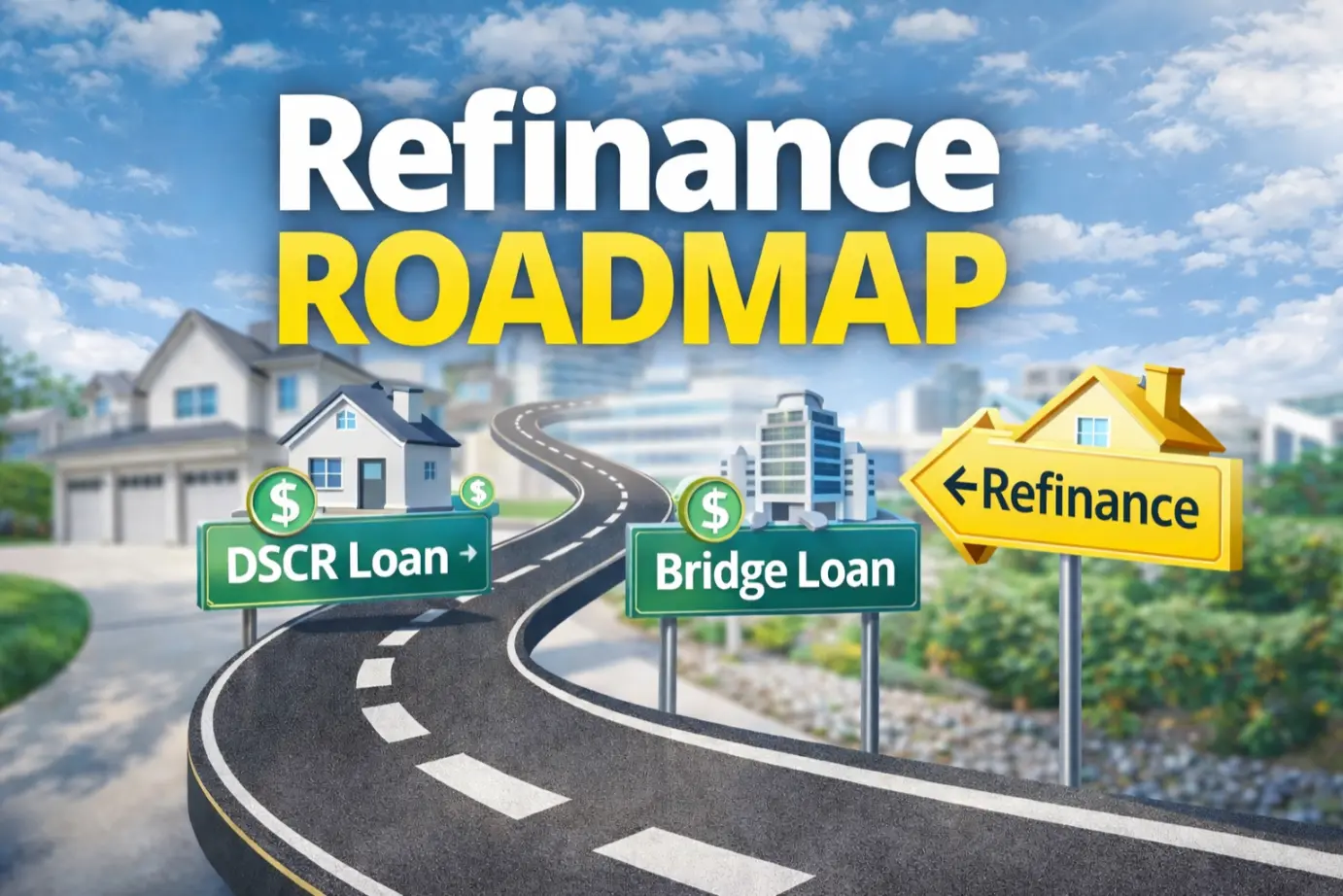
The refinance path from bridge funding to permanent financing follows a predictable pattern that most investors can complete in 9-15 months. Here’s your roadmap:
| Phase | Timeline | What Happens | Action Items |
|---|---|---|---|
| Acquisition | Month 0-1 | Close on the property with a bridge loan; take possession | Secure a hard money loan; finalize purchase; document property condition with photos; establish LLC or entity if needed |
| Renovation | Month 2-4 | Complete all rehab work and improvements | Finish all repairs; pull and close permits; document before/after with photos; ensure property is rent-ready; address any code violations |
| Tenant Placement | Month 5-6 | List the property and secure a qualified tenant | Set market rent based on comparable properties; screen tenants thoroughly; execute lease agreement; collect first month’s rent and security deposit |
| Seasoning Period | Month 7-12 | Tenant occupancy; establish rent payment history | Collect and document monthly rent payments; maintain property; build 6-12 months of payment history; establish property cash flow pattern; accumulate cash reserves |
| Refinance Prep | Month 10-11 | Begin the DSCR loan application process | Contact DSCR lenders; gather rent rolls and lease documentation; prepare entity docs; compile 6+ months of rent payment history; calculate current DSCR |
| Appraisal & Closing | Month 12-15 | Order appraisal; underwriting; close DSCR loan | Professional appraisal confirms market value; DSCR underwriting reviews property income; final approval; close on long-term loan; pay off bridge loan |
Pro tip: Start your DSCR refinance process at month 10-11, even if your bridge loan doesn’t mature until month 15-18. This gives you buffer time for any appraisal issues or lender delays without facing balloon payment pressure.
DSCR Refinance Requirements: The Lender’s Checklist
Successfully refinancing from bridge funding to DSCR financing requires meeting specific benchmarks that prove your investment property is a stabilized, income-generating asset.
Lenders will verify your income, often using lease agreements for long-term rentals. For short-term rentals, lenders may require income documentation from platforms like Airbnb or VRBO to assess the property’s cash flow.
In 2026, the required documents for refinancing include:
- Lease agreements or short-term rental income documentation
- Entity documents if the property is held in an LLC
- Property insurance and tax statements
Key Requirements:
Minimum DSCR of 1.25+ – Your property’s rental income must exceed your total mortgage payment by at least 25%. Some investor-focused products approve loans with DSCR as low as 1.0, but expect higher interest rates.
Loan-to-Value at 75-80% – You’ll need 20-25% equity in the property to qualify. Property type matters—single-family rentals typically qualify for higher LTV ratios than multi-family properties.
6-12 Months Rent Seasoning – DSCR lenders want proof that your rental income is real, documented, and consistent. A property rented for only 2-3 months doesn’t prove long-term income potential.
6-12 Months Cash Reserves – DSCR lenders require cash reserves equal to 6-12 months of PITI per property in liquid accounts.
Documentation You’ll Need:
✅ Executed lease agreement with 6+ months payment history
✅ Rent roll via bank statements
✅ Rent comparables proving market rate rent
✅ Property insurance with the lender as mortgagee
✅ Entity documents (LLC/Corp)
✅ Bank statements showing reserves
✅ Post-renovation appraisal
Your Bridge-to-DSCR Refi Checklist

Use this actionable checklist to stay on track and avoid costly delays during your refinance process, from bridge funding to permanent financing.
Pre-Refinance Preparation (3-6 Months Before)
- Verify property is rent-ready – All renovations complete, permits closed
- Place quality tenant – Execute comprehensive lease agreement
- Set market rent correctly – Pull rental comps
- Document everything – Save lease, rent rolls, bank statements, renovation invoices
- Build cash reserves – Accumulate 6-12 months PITI in liquid accounts
- Calculate your DSCR – Confirm property income supports a minimum DSCR of 1.25+
- Research DSCR lenders – Compare interest rates and loan terms
- Review entity structure – Ensure LLC documents are current
Application Phase (60-90 Days Before Maturity)
- Submit DSCR loan application – Apply with 2-3 lenders
- Provide 6+ months rent payment history – Show consistent payments
- Order property insurance – Lender must be listed as mortgagee
- Gather entity documents – Operating agreement, EIN letter
- Compile rent comps – Prove your rent is at market rate
- Order appraisal – Confirm market value supports refinance
- Submit all documentation promptly – Avoid delays
Closing Phase (30 Days Before Maturity)
- Complete underwriting requirements – Provide additional documentation
- Review final loan terms – Confirm DSCR, LTV, and interest rate match expectations
- Coordinate with the title company – Ensure a clear title
- Verify payoff amount from bridge lender – Confirm exact payoff figure
- Prepare closing funds – Wire closing costs to the title company
- Attend closing – Sign documents, fund DSCR loan, payoff bridge loan
- Confirm bridge loan payoff – Verify short-term loan is satisfied
5 Common Mistakes That Kill Your Bridge-to-DSCR Refinance
Mistake #1: Refinancing Too Early – Investors who rush to refinance after just 2-3 months of tenant occupancy are instantly declined. Lenders require seasoning—proof that rental income is stable, not speculative. Wait until month 10-12 minimum.
Mistake #2: Underestimating Post-Rehab Appraisal Value – Appraisers use recent closed sales, not your renovation costs. Before you acquire bridge funding, pull comparable sales from the last 90 days. Be conservative when calculating your exit strategy.
Mistake #3: Poor Exit Strategy Math – Run your DSCR calculation before you buy the property. Use conservative numbers: actual market rent, realistic operating expenses (30-40% of gross rent), and current interest rates for DSCR financing. If the math doesn’t support 1.25+ DSCR, the deal doesn’t work as a long-term rental.
Mistake #4: Missing Documentation – Create a dedicated digital folder the day you close on your bridge loan. Save everything: lease agreements, rent payment records, bank statements, renovation receipts, permit documents, insurance policies, entity papers, and rental comps.
Mistake #5: Waiting Too Long to Start – At month 10 of your bridge loan, begin shopping DSCR lenders. Submit your complete application by month 11-12. This timeline accounts for typical processing delays and prevents balloon payment pressure.
Bridge-to-DSCR FAQs
Can I refinance to DSCR with a brand-new lease?
No. Most DSCR lenders require 6-12 months of documented rental income and payment history before approving your loan. A lease signed last month doesn’t demonstrate the property’s ability to generate consistent property cash flow. Plan your exit strategy around the seasoning requirement from day one.
What if my DSCR ratio is lower than 1.25?
You still have refinance options, but expect higher interest rates or larger down payment requirements. Some investor-focused products approve DSCR as low as 0.75, though at significantly higher borrowing costs. To improve your DSCR, consider increasing rent to market rate, reducing expenses, or putting down more money.
Do I need perfect credit to get a DSCR loan?
No. Most DSCR programs accept credit scores as low as 620-660, though borrowers with strong credit receive better interest rates. At Gelt Financial, we don’t require a minimum credit score for bridge loans, and we work with borrowers across the credit spectrum because real estate investors are judged by their deals, not their FICO scores.
What if I can’t refinance before my bridge loan matures?
Contact your hard money lender immediately to discuss extension options. At Gelt Financial, we offer short-term extensions (3-6 months) if your property is performing and you have a clear exit strategy. Extensions typically cost 1-2 points but are far better than defaulting. Call me at 561-221-0900 to discuss your situation.
How does a DSCR loan work?
A DSCR loan works by evaluating your property’s ability to generate income rather than your personal income or tax returns. Lenders calculate your debt service coverage ratio by dividing the property’s net operating income by the total monthly mortgage payment (PITI). If your rental income exceeds the debt payment by at least 25% (DSCR of 1.25), you typically qualify.
Unlike conventional mortgage products, DSCR rental loans require no income verification, tax returns, or employment documentation—making them ideal for self-employed investors and those with complex finances. The property’s rental income is the only qualification metric that matters, which is why real estate investors who focus on portfolio growth prefer DSCR financing for long-term rentals.
When Bridge-to-DSCR Doesn’t Make Sense
Not every investment property is destined for DSCR refinancing. Here are alternatives:
Extending Your Hard Money Loan – Bridge loan extensions buy you time when you need another 3-6 months to meet DSCR requirements. Extensions work best when your tenant moves in during months 4-5, and you need to reach the seasoning threshold.
Selling the Property – Sometimes, the most brilliant exit strategy is to sell rather than refinance into long-term loans. Consider selling when your DSCR ratio won’t support refinancing or when you want to redeploy capital into your next deal.
Portfolio Lending Options – For investors with multiple properties, portfolio lending evaluates your entire real estate portfolio rather than just a single property. This helps investors achieve strong overall portfolio growth, but individual properties might have marginal debt-service coverage ratios.
Need a Hard Money Loan That Sets You Up for Easy Refinancing?
Most investors fail at the bridge-to-DSCR transition because they choose the wrong bridge loan from the start. At Gelt Financial, we structure hard-money loans designed for smooth exits into permanent financing, whether through DSCR programs, portfolio lending, or cash-out refinancing.
As a direct portfolio lender with 35+ years of experience, we understand that your bridge loan isn’t just about acquisition; it’s the foundation for your entire investment plan, portfolio growth, and long-term wealth building through real estate investing.
Why my bridge loans set you up for refinancing success:
✅ 3-5 day closings to acquire properties fast – While other loan products take 30-45 days, we close in less than a week, so you can secure deals before competitors, negotiate better purchase prices, and start renovations immediately.
✅ No minimum credit score – asset-based approval – we evaluate your deal, not your FICO score. Whether you’re a first-time investor building your first rental or a seasoned pro with complex finances, my flexible underwriting focuses on the property’s income potential and your exit strategy.
✅ Direct access to decision-makers (not a broker) – You’re talking to the person who approves and funds your loan. This means faster answers, creative loan structure solutions, and flexibility that brokers cannot offer.
✅ Flexible terms that align with your refinance timeline – we structure loan terms (6-24 months) based on your specific deal. Need 18 months to stabilize and refinance into DSCR financing? We build that into your loan from day one.
✅ 35+ years of experience helping investors succeed – Gelt Financial has closed over 10,500 loans across 38 states. That experience translates into practical guidance that helps you avoid the common mistakes that kill refinances.
Our bridge funding isn’t just short-term loans; it’s strategic capital designed for your specific investment strategy. Whether you’re acquiring single-family rentals, small multifamily properties, mixed-use buildings, or other property types, we structure the right loan to support your plan from acquisition through a successful refinance or sale.
Ready to acquire your next investment property with a bridge loan built for easy refinancing?
Don’t wait until you’re scrambling to refinance 30 days before your balloon payment. Start with a hard money lender who understands where you’re going, not just where you are today.
Talk to Us Today: 561-221-0900
We are ready to discuss your deal, answer questions about DSCR refinancing, and structure bridge funding that aligns with your investment timeline. No call centers, no runarounds, just direct conversation with the person who can approve your loan and help you build lasting wealth through real estate investing.